
Our programs are designed to provide focused, high-impact training for dental professionals to enhance knowledge, hands-on experience and clinical skills. Stay updated with the latest professional training programs by Elite Academy.
Coming soon!
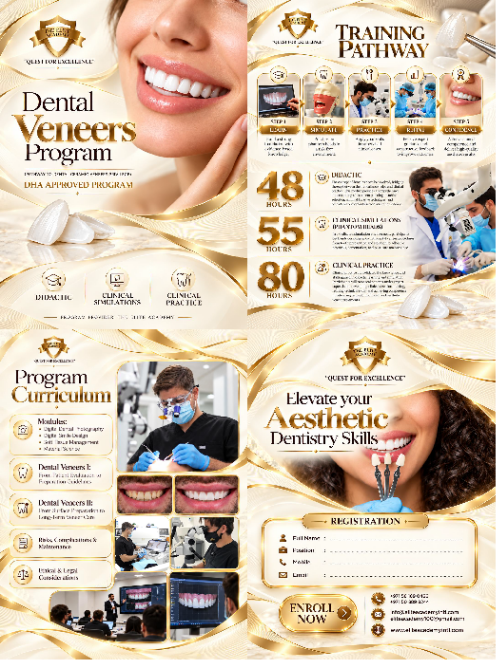
Dental Ceramic Veneers Training Program
(Pathway to Ceramic Veneers Privilege)
DHA APPROVAL
Rationale
This innovative program aims to address the needs of dental practitioners at enhancing their knowledge and improving their clinical skills in preparing dental veneers in a comprehensive & integrated approach to be eligible to receive the DHA privilege for ceramic veneers as per the DHA regulations.
This comprehensive program includes didactic components (lectures), group discussions/case studies, hands on, clinical simulations using phantom heads, clinical practice, final assessment and clinical case presentations to build the trainees’ knowledge and enhance their clinical skills
The program covers all aspects of dental veneers in a multidisciplinary approach to allow participants to better understanding the fundamentals of dental veneers workflow, tips & tricks in a more efficient and comprehensive manner.
Program Learning Objectives
By the end of the program, participants shall be able to:
LO1. Identify the indications of each type of dental veneers
LO2. Assess holistically the principles and guidelines for dental veneers preparations
LO3.Perform comprehensive patient assessment and treatment planning for aesthetic cases involving dental veneers.
LO4. Demonstrate competencies in isolation, impression taking, temporization and cementation techniques
LO5. Manage soft tissues and gingival aesthetics to achieve predictable aesthetic outcomes.
LO6. Formulate a sound and comprehensive treatment plan for dental veneers restorations
LO7. Perform try-in, cementation, finishing, and polishing procedures using evidence-based clinical protocols.
Program Modules
Digital Dental Photography & Digital Smile Design
Soft Tissue Management & Dental Occlusion in Everyday Practice
Material Science for Dental Veneers & Patient Evaluation
Dental Veneers: Preparation Guidelines
Dental Veneers: Adhesion & Surface treatment, Bonding & Cementation
Dental Veneers: Clinical Simulations Using Phantom Heads
Risks, Complications & Maintenance / Ethical & Legal Considerations
Program’s Details
Digital Dental Photography & Digital Smile Design
Description
Considering the evolution of the dental practice towards digital dentistry, it is important to consider the use of digital photography for documentation and referral purposes; participants will acquire the skills, techniques and the most current technical trends of digital photography through proper positioning, framing and use of lighting for successful.
Smile designing is a comprehensive, interdisciplinary approach towards aesthetic improvement; participants will acquire the aesthetic principles and knowledge of smile design, thus, developing artistic capacities to better understanding the patients’ emotional perception.
Learning Objectives
Participants are expected to:
LO1. Understand the key components of dental photography
LO2. Differentiate the elements of the camera system used for dental photography
LO3. To adjust settings of any camera & identify the different flash sources
LO4. Implement protocol and relevant guidelines for professional-quality photography with the tips and techniques of dental photography
LO5. To capture photos needed for digital treatment planning and documentation
LO6. To master DSD Protocols and steps
LO7. Develop a holistic treatment planning
LO8. Demonstrate competency to design a Smile Design
LO9. Collaborate with lab technician
Digital Dental Photography / Shade Management
Topics
Digital Dental Macrophotography
Protocol
Camera Body: Macro lens camera or DSLR
Accessories: Ring flash or twin flash, Cheek
retractors, Intraoral mirrors, Contrastors
Shade Mapping Techniques
Lab Communication
Protocol
Clinical Applications of Digital Dental Photography
Digital Smile Design
Topics
Principles of Digital Smile Design
Aesthetic
Guidelines & Digital Smile Design
Facial Analysis & Treatment Planning
Applications
The Golden Proportion
Lab Communication & Aesthetic Diagnosis
Soft Tissue Management & Dental Occlusion in Everyday Practice
Rationale for Soft Tissue Management:
Successful dental ceramic veneers restorations rely on tooth preparation, ceramic veneer selection but also on the health of the surrounding soft tissues; proper soft-tissue management ensures longevity, optimal aesthetics & biological compatibility of the ceramic veneer margins.
Soft Tissue Management
Description
This module will address the soft tissue management complexity and challenges related to successful
aesthetic dental ceramic veneers restorations; participants will be provided with the concepts of
soft tissue management to ensure long term successful results within the surrounding soft tissues to
avoid any future complication with emphasize on the inter disciplinary relations to achieve better
aesthetic results.
Demonstration and hands on Soft Tissue Management: Crown lengthening and
suturing techniques using sheep heads and laser technique.
Learning Objectives
At the end of this course, participants should be able to:
LO1. Understand the complexity of soft
tissue management
LO2. Differentiate the various incision designs and suturing techniques
LO3.
Initiate a treatment planning in a more comprehensive approach
Topics
Pre Treatment Soft Tissue Evaluation
Margin
Position & Biologic Width
Gingival Retraction Techniques
Laser & Surgical Procedures /
Flap Designs & Gingival Recontouring
Suturing Techniques
Maintenance of Soft Tissue Post
Cementation
Soft Tissue Complications & Prevention
Clinical Case Discussions
Dental Occlusion in Everyday Practice
Description
This session will expose participants to the most challenging dental practice that is fundamentals of occlusal adjustments and occlusion analysis and its correlations to achieve a successful FMR treatment with a step-by-step approach on occlusal adjustment, using digital occlusal analysis.
Learning Objectives
Upon completion of the module, participants are expected to:
LO1. Differentiate between the centric relation and the centric occlusion
LO2. Understand and analyze the concepts of Facebow Transfer, Occlusal Adjustment and Centric Relation Records
LO3. Demonstrate competencies in centric relation records, bite registration and occlusion analysis
Topics
Importance of Occlusion
Functional Guidance
& Occlusal Planning
Fundamentals of Occlusal Adjustment
Vertical Dimension of Occlusion
Digital Occlusion Analysis
Requirements of a Stable Occlusion
CAD/CAM Restoration Types
Occlusal Concepts in Rehabilitation
Centric relation and occlusion
Vertical dimension of occlusion (VDO)
Strategy for Anticipating Functional Load:
Avoiding High Stress Contacts on Thin
Ceramic
Managing Parafunction & Night Guard Indications
Digital Occlusion Technologies:
Digital Facebows & Jaw Tracking
CAD/CAM Design Software
Material Science for Dental Ceramic Veneers & Patient Evaluation
Material Science for Dental Ceramic Veneers
Description
From a material science perspective, dental ceramic veneers are engineered composites that combine esthetic excellence with functional performance. Their success is based on optimized ceramic composition, controlled microstructure, adequate mechanical strength, and reliable adhesive bonding to natural tooth structure.
Learning Objectives
By the end of this topic, learners should be able to:
LO1. Understand the composition and classification of dental ceramic materials used for veneers
LO2. Compare mechanical properties such as strength, fracture toughness, and brittleness among different ceramic veneer materials.
LO3. Explain bonding mechanisms between ceramic veneers, resin cements, and tooth structure, including the role of etching and silane coupling agents.
LO4. Assess the indications and limitations of various ceramic materials for veneer applications based on material science principles.
LO5. Apply material science concepts to clinical decision-making for selecting appropriate ceramic veneer materials.
Topics
Introduction to Dental Veneers
Veneers:
Indirect Veneers:
Types of Indirect Veneers
Indications & Contraindications for Veneers
Placement
Thickness Recommendations
The Eight Rules for Veneers Placement
Tips for
Successful Veneers Placement
Overview & Classification: Feldspathic & Lithium Disilicate,
Zirconia Veneers,
Lumineers (No prep)
Composition & Microstructure
Mechanical &
Optical Properties
Indications & Contraindications for Dental Ceramic Veneer
Placement
Factors Affecting Material Selection
Advantages & Limitations
Preparation
Requirements & Thickness Recommendations
Interdental Contact Areas & Points
Case
Selection Criteria for each Type of Veneer
Patient Evaluation
Description
Patient evaluation is a critical step in determining the suitability and long-term success of ceramic veneers. It involves a comprehensive assessment of esthetic expectations, oral health, functional factors, and patient-related considerations.
Learning Objectives
By the end of this topic, learners should be able to:
LO1. Evaluate medical and dental history to recognize conditions that may influence veneer treatment outcomes.
LO2. Interpret radiographic findings relevant to ceramic veneer planning
valuate surrounding tissues and tooth health
LO3. Perform a comprehensive esthetic analysis, including tooth form, color, alignment, smile line, and gingival architecture.
Topics
Patient Selection Criteria / Patient
History
Clinical Assessments & Diagnosis Steps
Mock up & Digital Wax up
Planning
Digital Dental Photography Records
Aesthetic Analysis & Digital Smile
Design
Radiographic Examination
Occlusal & Shade Analysis
Final Treatment
Plan
Documentation, Records & Informed Consent Form
Dental Ceramic Veneers: Preparation Guidelines
Teeth Preparation Workflow
Description
The teeth preparation workflow for ceramic veneers is a systematic, minimally invasive process designed to preserve enamel, ensure optimal esthetics, and provide durable bonding. Each step is carefully planned to achieve predictable clinical outcomes.
Learning Objectives
By the end of this topic, learners should be able to:
LO1. Describe the sequential steps involved in the teeth preparation workflow for ceramic veneers.
LO2. Integrate preparation principles into clinical decision-making to ensure predictable, long-lasting ceramic veneer restorations.
Topics
Diagnosis & Treatment Planning
Types of
Teeth Preparations
Conventional Preparation
No Prep Technique: Diastema Closure
Limitations
of No-Prep Approach
Minimal Preparation: For Larger Diastemas
Criteria for Lumineers vs
minimal preparation vs conventional
Enamel Preservation
Impression Taking
Impression
taking, Temporization & Shade Selection
Tooth Proportion
Margin Selection
Tooth
Rotation Management:
Mild Rotations: No-Prep Veneers
Moderate Rotations: Minimal-Prep
Veneers
Clinical Cases Discussion
Clinical Simulations using phantom heads (8 hours)
Demonstration on Preparation Techniques
Live
Mock Up
Veneer Tooth Preparation: 8 anterior teeth (14–24)
Participants will work on phantom
heads, on teeth # 14,13,12,11,21,22,23,24
Dental Ceramic Veneers: Adhesion / Surface Treatment; Bonding & Cementation Workflow
Description
The long-term success of dental ceramic veneers relies on effective adhesion between the ceramic restoration, resin cement, and tooth structure. This is achieved through precise surface treatment and a controlled bonding and cementation workflow.
Learning Objectives
By the end of this topic, learners should be able to:
LO1. Differentiate surface treatment protocols for various ceramic materials, including glass-based ceramics and zirconia.
LO2. Describe the step-by-step bonding and cementation workflow for ceramic veneers.
LO3. Explain tooth surface conditioning procedures, including enamel etching and adhesive application.
LO4. Identify common causes of bonding failure and explain methods to prevent contamination and debonding.
Topics
Adhesive Resin Cement
Impression / Digital
Scanning
Provisional Veneers
Lithium Disilicate & Feldspathic Ceramics: Hydrofluoric Acid (HF Etching &
Silanization)
Surface Treatment Protocol:
Hydrofluoric Acid Etching
Rinsing &
Drying
Ultrasonic Cleaning
Silanization
Zirconia Veneers: (Air Abrasion, Methacryloyloxydecyl Dihydrogen Phosphate (MDP) Primers &
Adhesive Resin Cement)
Surface Treatment Protocol: Mechanism: Chemical bond between phosphate
group and zirconium oxide
Air Abrasion
MDP-Based Primers
Bonds Protocol
Try in pastes and shade selection
Provisional Veneers
Seating sequence and clean up
Light curing protocols for thin ceramic and zirconia
Cementation / Luting Procedure: Light Cure Resin Cement Application
Veneer Seating
Remove
excess cement
Finishing and Polishing Guidelines
Clinical Simulations using Phantom Heads (8 hours)
Veneer Tooth Preparation: 8 anterior teeth
(14–24)
Demonstration on Isolation & Impression Taking
Participants will work on Isolation
& Impression Taking using phantom head’s teeth # 14, 13, 12, 11, 21, 22, 23, 24
Dental Ceramic Veneers:
Clinical Simulations using Phantom Heads (8 hours)
Veneer Tooth Preparation: 8 anterior teeth (14 – 24)
Demonstration on Temporization & Cementation using phantom Heads
Participants will work on Temporization & Cementation using phantom heads on teeth # 14,13,12,11,21,22,23,2,4
Risks, Complications & Maintenance
Ethical & Legal Considerations
Description
Successful ceramic veneer procedures extend beyond clinical placement. Understanding potential risks and complications, ensuring proper maintenance, and adhering to ethical and legal standards are essential for long-term success and professional responsibility.
Learning Objectives
By the end of this topic, learners should be able to:
LO1. Describe preventive strategies to minimize risks and complications through proper case selection, technique, and material choice.
LO2. Explain maintenance protocols required to ensure the long-term success and longevity of ceramic veneers.
LO3. Integrate risk management, ethical reasoning, and legal awareness into clinical decision-making for ceramic veneer treatment.
Topics
Risks: (Before & During Treatment); Complications: Post Operative Sensitivity, Biological & Occlusal Risks; Enamel Removal; Classification of Dental Ceramic Veneers
Complications: Aesthetic / Mechanical / Biological / Functional; Complications: Post Ceramic Veneers Delivery
Veneer Debonding; Chipping or Fracture; Marginal Staining; Gingival Recession;
Maintenance Protocol
Patient Education ; Daily Patient Maintenance ; Professional Maintenance
Ethical & Legal Considerations as per the UAE Health Authorities Regulations; Licensing & Scope of Practice (legal requirements) Qualifications Requirements; Local Regulatory Authority Requirements; Scope & Competency; Ethical Practice Standards; Ethical & Patient-Rights Considerations
Documentation & Legal Liability; Records Keeping; Records & Data Protection; Advertising & Marketing Regulations; Advertising Ethics
Liability; Informed Consent Form & Patients Communication; Conflict of Interest
Malpractice Claims; Federal & Local Frameworks; MoHAP & Federal Laws; Local Health Authorities (e.g., DHA, DoH, SHA)
Program Summary:
Total Theory Hours: 48 Hours
Total Hands on/ Clinical simulations: 55 Hours
Clinical Practice (on patients): 80 Hours
20 Dental Veneers Cases
Final Assessment: 2 Hours
Clinical Case Presentations: 12 Hours
Clinical Session Schedule:
Morning Session: 09:00 am - 01:00 pm
Afternoon Session: 02:00 pm - 06:00 pm
N.B: All clinical sessions shall be supervised by trainers and patients must be informed about the consent form and sign it; all steps shall be overseen and signed by the trainers on each participant's log book.
Professional Diplomas
- Professional Diploma in Digital Aesthetic Dentistry – 6 Modules
- Professional Diploma in Microscopic Endodontics – 4 Modules
Master Classes
- Master Classes in Microscopic Endodontics – 2 Modules — January 23rd & 24th, 2027; March 27th & 28th, 2027
- Master Classes in Ceramic Veneers – 2 Modules — February 6th & 7th, 2027
- Master Class in Aligners Workflow – 2 Modules
Certificates / Short Courses
- Digital Dental Photography & Digital Smile Design – 1 Module
- FMR Digital Workflow & Digital Occlusion – 1 Module
- Soft Tissue & Pink Aesthetic – 1 Module
- Aesthetic Direct Restorations – 1 Module
- Implants Placement in the Aesthetic Zone – 1 Module
- Piezosurgery Procedures in Oral & Implantology – 1 Module
- ADAM Course – 1 Module
- Advanced ADAM Course – 1 Module
- Root Canal Procedures: A Step-By-Step Guide: From Access Cavity to RC Obturation– 1 Module
- Complications & Root Canal Retreatment – 1 Module
Professional Diplomas
The Professional Diplomas programs have been crafted by the Elite Academy with an academic mindset to ensure the qualitative efficiency of the programs’ delivery; as such, all programs consist of lectures, case-based discussions/clinical case studies, hands on, clinical simulations using phantom heads in addition to a midterm assessment, final assessment and clinical case presentations.
Professional Diploma in Digital Aesthetic Dentistry (6 Modules)
Program Overview
The Professional Diploma in Digital Aesthetic Dentistry is a multidisciplinary, competency-based training program crafted to enhance the knowledge and improve the clinical skills of the dental practitioners in digital aesthetic dentistry through the integration of digital technologies with focus on the diagnosis, treatment planning, and implementation of aesthetic dental procedures using digital workflows.
Outcomes
Understand the principles of digital technologies in aesthetic dentistry.
Integrate digital dentistry workflows into multidisciplinary dental procedures for clinical accuracy & efficiency.
Demonstrate competency in modern digital dental technologies.
Formulate and implement minimally invasive aesthetic procedures.
Program Structure
Module 1: Digital Dental Photography & Digital Smile Design
Module 2: Aesthetic Direct Restorations
Module 3: Ceramic Veneers: From A to Z
Module 4: Ceramic Veneers Workflow
Module 5: Laser Soft Tissue & Pink Aesthetics
Module 6: Final Assessment
Clinical Case Presentations
Topics
Principles of Dental Photography:
Protocols & Standards for Dental Photography
Camera Body: Dental macro Photography
Macro Lens Exposure & Shooting Modes
Editing & Compiling Dental Photography
Tips to improve Dental Photography
Principles of Smile Design:
Smile Design Basics & Smile Design Analysis
Smile Diagnosis & Treatment Planning
Shade Selection
Patient Management
Lab Communication Skills
Clinical Protocols & Patient Management
Patient Case Presentations & Discussion
Hands on Dental Photography and Digital Smile Design
Module 2: Aesthetic Direct Restorations
Description
This module provides comprehensive training in the application of composite veneers, focusing on the principles, techniques, and aesthetic considerations. The course combines theoretical lectures and practical hands-on sessions using phantom heads, allowing participants to develop the skills needed for successful composite veneer restorations in clinical practice.
Outcomes
By the end of this course, participants will be able to:
Identify cases suitable for composite veneer restorations.
Demonstrate appropriate shade matching and layering techniques.
Perform cavity preparation and veneer application on phantom heads.
Achieve natural-looking, durable composite veneers with proper finishing and polishing.
Manage common challenges and complications associated with composite veneers.
Topics
Introduction to Composite Veneers
Indications and Contraindications
Material Science of Composites
Shade Selection Principles
Case Selection and Treatment Planning
Clinical Cases Presentations & Discussion
Clinical Simulations
Shade matching exercises
Basic veneer cavity preparation techniques
Layering Techniques for Composite Veneers
Adhesion Protocols and Isolation Techniques
Contouring and Sculpting Principles
Finishing and Polishing Techniques
Module 3: Ceramic Veneers: From A to Z
From A to Z
Hands on: From Preparation to Cementation
Description
This interdisciplinary course will provide a systematic and comprehensive approach from ceramic veneer preparations to a successful veneer delivery, thus, achieving a natural look aesthetic veneer result.
The presentations will address all aspects of ceramic veneers preparations from smile analysis to dental photography and predictable final outcome for ceramic veneers.
Outcomes
Identify the criteria & indications for successful ceramic veneers aesthetic restorations.
Assess holistically the principles and guidelines for ceramic veneers preparations.
Demonstrate competencies in formulating a predictable final outcome for ceramic veneer preparations.
Topics
Direct & Indirect Ceramic Veneers
Veneers Preoperative Evaluation
Criteria for Esthetic Restorative Success
Zenith
Mock up
Predictable Final Outcome for Ceramic Veneers
Preparation Guidelines in Veneers
The Eight Rules for Veneers Placement
Tooth Proportion
Tips for Successful Veneers Placement
Impression taking, Temporization & Cementation
Challenges faced in veneers preparations
Conceptual Differences in Crowns and Veneers
Non Prep veneers, Limitations & Challenges
Clinical Simulations
Following demonstrations, each participant will have 8 teeth, from tooth # 14 to tooth # 24 using phantom heads and rubber dam for ceramic veneer preparations.
Module 4: Ceramic Veneers Workflow
Description
This module will expose participants to the most challenging dental practice that is FMR digital workflow & digital occlusion with emphasize on the treatment planning concepts and prognosis for extensively damaged teeth.
Outcomes
Understand the importance of digital technologies in treatment planning and prognosis assessment of FMR & digital occlusion.
Topics
Clinical Simulations
Module 5: Laser Soft Tissue & Pink Aesthetics
Description
This module will address the soft tissue management complexity and challenges related to successful aesthetic dental ceramic veneers restorations; participants will be provided with the concepts of soft tissue management to ensure long term successful results within the surrounding soft tissues to avoid any future complication with emphasize on the inter disciplinary relations to achieve better aesthetic results.
Demonstration and hands on Soft Tissue Management: Crown lengthening and suturing techniques using sheep heads and laser technique.
Learning Objectives
At the end of this course, participants should be able to:
LO1. Understand the complexity of soft tissue management
LO2. Differentiate the various incision designs and suturing techniques
LO3. Initiate a treatment planning in a more comprehensive approach
Topics
Pre Treatment Soft Tissue Evaluation
Margin Position & Biologic Width
Gingival Retraction Techniques
Laser & Surgical Procedures / Flap Designs & Gingival Recontouring
Suturing Techniques
Maintenance of Soft Tissue Post Cementation
Soft Tissue Complications & Prevention
Clinical Case Discussions
Module 6: Final Assessment
Clinical Case Presentations
The Final Assessment is designed to assess the program’s outcomes from the participants’ perspective to ensure that participants demonstrate competency in formulating & implementing, minimally invasive aesthetic restorations.
The Clinical Case Presentations constitute an essential component of the program; they are designed to assess the participant’s knowledge & clinical skills to integrate digital technology, aesthetic principles, evidence-based clinical decision in their aesthetic restorations.
Professional Diploma in Microscopic Endodontics (4 Modules)
Program Overview
This innovative program aims to address the needs of dental practitioners at enhancing their knowledge and improving their clinical skills in Microscopic Endodontics using magnification and teeth isolation.
This comprehensive program includes didactic components that consist of lectures, group discussions/case studies, microscopic clinical simulations with clinical evidence-based to incorporate the latest trends and technology of Microscopic Endodontics into their daily practice; such approach will allow participants to gain confidence & experience and optimize their knowledge in addressing the more challenging cases in Microscopic Endodontic procedures.
Outcomes
Acquire the didactic knowledge and clinical skills of the principles of Microscopic Endodontics
Gain confidence to work under magnification and teeth isolation using h rotary Endodontic instruments
Get ability to apply the various treatment modalities to achieve predictable results
Demonstrate competency for root canal treatments in a more conservative approach
Program Structure
Module 1
Root Canal Procedures: A Step-By-Step Guide from Access Cavity to Root Canal Obturation.
Module 2
Complications & Root Canal Retreatment
Module 3:
Tooth Reconstruction After RCT: From Core Build-Up and Post Placement to Final Restoration
Module 4: Final Assessment
Clinical Case Presentations
Program Details
Module 1
Root Canal Procedures: A Step-By-Step Guide from Access Cavity to Root Canal Obturation.
Module Overview
This module will address the new trends in Microscopic Endodontics with emphasize on minimally invasive Microscopic Endodontics and focus on the protocols of rotary Endodontics such as diagnosis & dental imaging, from teeth isolation, access cavity, using rotary instruments, electronic apex locators, macro-glide path, root canal irrigation, cleaning & shaping the root canals and root canal obturation.
The workshop will consist of demonstration and clinical simulation using microscopes and teeth isolation on how to initiate an access cavity, defining the working length, reproducing a glide path, cleaning and shaping canals and root canal treatment.
Module Structure
Topics
Ergonomics in Magnification
Teeth Isolation
Access Cavity
Glide Path
Working Length Determination
Irrigation & Activation Protocol
Rotary Instruments: Tips & Tricks
Bioceramic Sealers
Module Outcomes
Gain confidence to apply rotary endodontic instruments
Assess the root canal preparations from access cavity to root obturation
Demonstrate capability to perform root canal obturations
Module 2
Complications & Root Canal Retreatment
Module Overview
This module will address the most challenging root canal clinical cases & and will address and present solutions for successful endodontics treatment, failure and retreatment.
Module Structure
Topics
CBCT in Microscopic Endodontics
Management of Root Perforation
Resorption Management
Ledges: Causes & Treatment
Retreatment Protocol
Broken Instruments Removal
Sealing of Perforations
Module Outcomes
Understand the importance of CBCT use
Identify the causes of root canal failures
Develop competency for root canal retreatments
Module 3
Tooth Reconstruction After RCT: From Core Build-Up and Post Placement to Final Restoration
Description
This module course focuses on the restoration and reconstruction of root canal-treated teeth, combining evidence-based theoretical knowledge with practical hands-on training. Participants will be exposed to the principles of post-endodontic restoration, assessment of remaining tooth structure, selection of restorative materials, fiber post placement, core build-up techniques, and preparation for definitive restorations; followed by a practical component to allow participants to perform selected restorative procedures using extracted teeth or phantom heads, enhancing their clinical skills and confidence.
Outcomes
By the end of this module, participants will be able to:
Evaluate the remaining tooth structure and assess restorability.
Identify the indications for direct and indirect restorations of endodontically treated teeth.
Develop evidence-based treatment plans to achieve predictable long-term outcomes.
Perform core build-ups using appropriate restorative materials.
Recognize and manage restorative complications and failures.
Topics
Assessment of remaining tooth structure and restorability.
Principles of post-endodontic restoration.
Ferrule effect and fracture resistance.
Indications and techniques for fiber post placement.
Post-and-Core Restorations
Direct Restorative Techniques
Indirect Restorative Techniques
Occlusion and Aesthetic Considerations
Complications, Maintenance and Long-Term Prognosis
Hands-on Training
Post space preparation: Demonstration and practice of post space preparation.
Fiber post placement: Adhesive cementation of fiber posts.
Core build-up: Reconstruction using composite core materials.
Direct composite reconstruction: Anatomical restoration of endodontically treated teeth.
Indirect restoration preparation: Preparation principles for crowns, onlays, and endocrowns.
Final restoration: Occlusal adjustment, finishing, and polishing.
Module 4: Final Assessment
Clinical Case Presentations
The Final Assessment is designed to assess the program’s outcomes from the participants’ perspective to ensure that participants demonstrate competency in formulating & implementing root canal obturations.
The Clinical Case Presentations constitute an essential component of the program; they are designed to assess the participant’s knowledge & clinical skills to formulate a sound treatment plan and perform root canal procedures.
PROFESSIONAL DIPLOMAS
PROFESSIONAL DIPLOMA IN DIGITAL AESTHETIC DENTISTRY
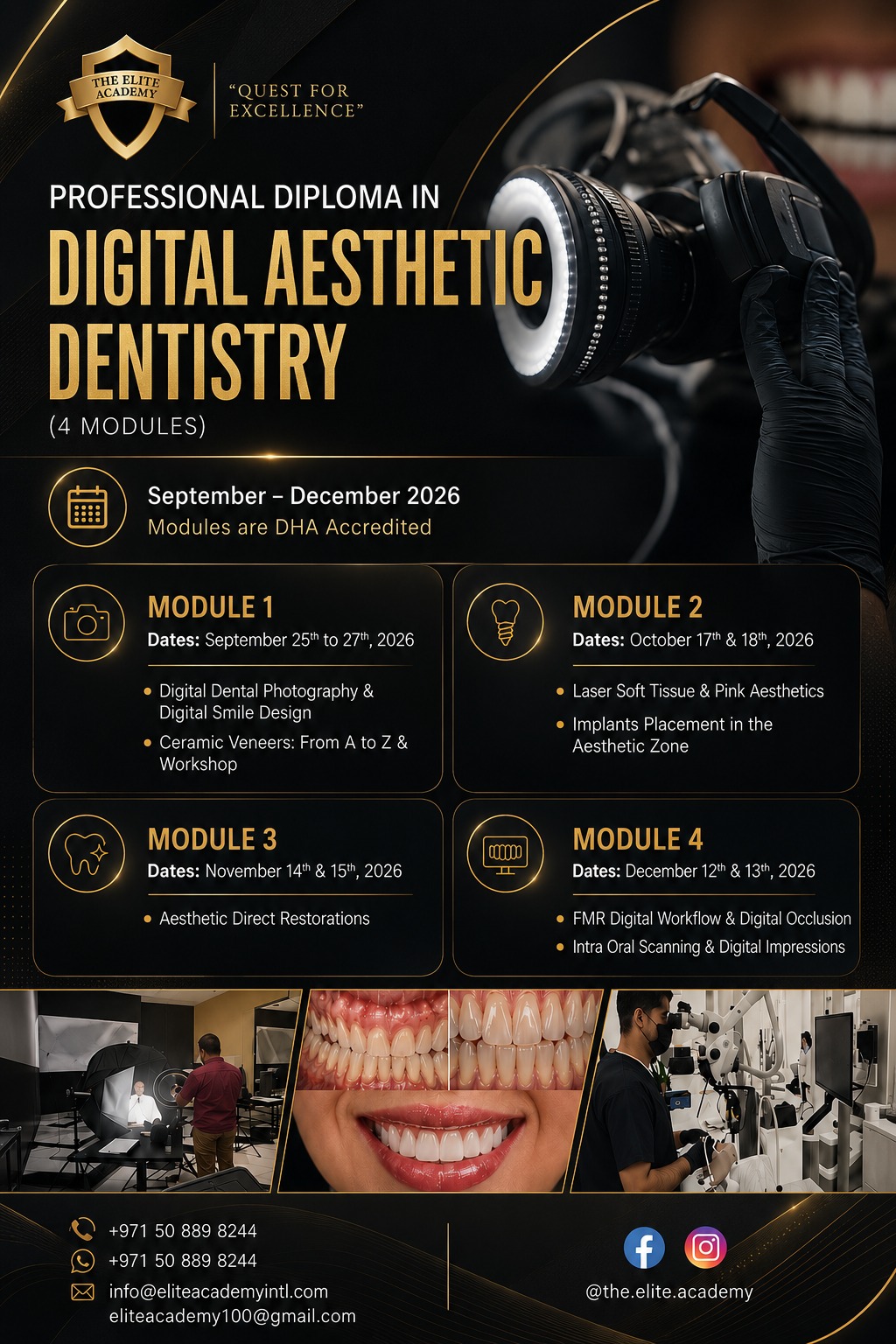
January – June 2027
PROFESSIONAL DIPLOMA MICROSCOPIC ENDODONTICS
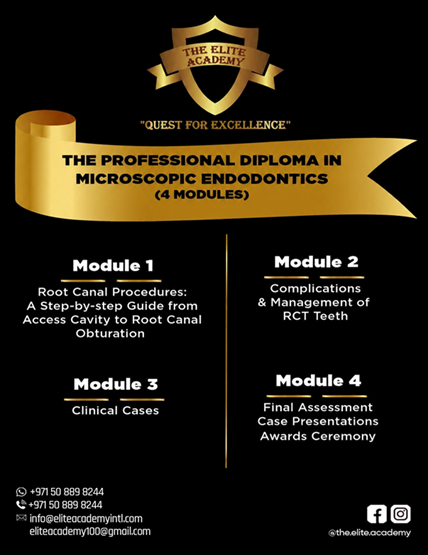
January – June 2027